
Warm minimalism interior design in Dubai is the clearest correction to a decade of stark white walls, cold grey stone, and glossy metallic accents that once defined luxury here. It keeps minimalism’s core discipline, restraint, clean lines, few but considered pieces, while trading the coldness for warmth: soft neutral tones, natural texture, and lighting that makes a room feel inhabited rather than staged. Done well, it’s the style most consistently associated with genuine, livable luxury in Dubai right now. Here’s what it actually means and how to get it right in your own home.
What Is Warm Minimalism?
Warm minimalism starts from the same principle as classic minimalism, fewer objects, cleaner lines, a restrained material palette, but rejects the coldness that often came with it. Where stark minimalism leaned on white walls, grey stone, and sharp, cool-toned metal accents, warm minimalism swaps that palette for sand and taupe tones, natural wood, and matte rather than high-gloss finishes, without adding a single extra object to the room.
The distinction matters because minimalism without warmth tends to feel unfinished or clinical in a home, a space that photographs well but doesn’t invite you to actually spend time in it. Warm minimalism solves that by keeping the discipline of restraint while making sure every remaining material and colour choice contributes genuine tactile and emotional warmth. It’s minimalism that still feels like a home, not a gallery.
This isn’t the same as a fully maximalist or heavily decorated style either. Warm minimalism still asks hard questions about what actually earns a place in the room, it just answers those questions with softer, more forgiving materials than the starker version of minimalism that came before it.
Why It Suits Dubai’s Lifestyle
Warm minimalism has taken hold in Dubai specifically, not just as a general global trend, because it solves real, local problems that a colder aesthetic doesn’t.
Dubai’s light is intense and golden for most of the year, and warm neutral tones flatter that quality of light in a way cool greys and stark white simply don’t. A room finished in sand, taupe, and warm wood tones reads as glowing and inviting under Dubai’s afternoon light, while the same room in cool grey and white can feel flat or even harsh under the same conditions.
There’s also a practical maintenance argument that gets less attention than it deserves. Dust is a constant reality in Dubai’s climate, and cool grey and stark white surfaces show it far more visibly than warm sand and earth tones do. Homeowners who chose a stark white kitchen or living space a few years ago are frequently the same clients now asking to warm up their palette, partly for the look, partly because it’s simply more forgiving to live with day to day.
And Dubai’s fast-paced, high-pressure lifestyle has pushed genuine demand for homes that function as a retreat rather than another polished, high-performance environment. Warm minimalism, with its emphasis on calm, texture, and restraint over show, directly answers that desire in a way louder, more maximalist luxury styles don’t.
There’s a cultural fit worth mentioning too. Warm minimalism leaves natural room for personal and cultural touches, a considered art piece, a subtle nod to Arabic architectural detailing like a mashrabiya-inspired screen, without those elements fighting against the room’s base palette the way they might against stark white or heavily patterned interiors. This is part of why the style has resonated so consistently across Dubai’s genuinely international, multicultural homeowner base.
The Palette: Earthy Tones and Texture
The palette is where warm minimalism is built or lost, and it’s worth understanding the logic behind it rather than treating it as a fixed colour chart.
Sand, taupe, warm greige, and soft earthy browns form the base of most warm minimalist interiors, replacing the stark white and cool grey that dominated Dubai homes a few years ago. These tones share a quality that matters more than the specific shade: they all sit on the warm side of neutral, avoiding the blue or green undertones that read as cold.
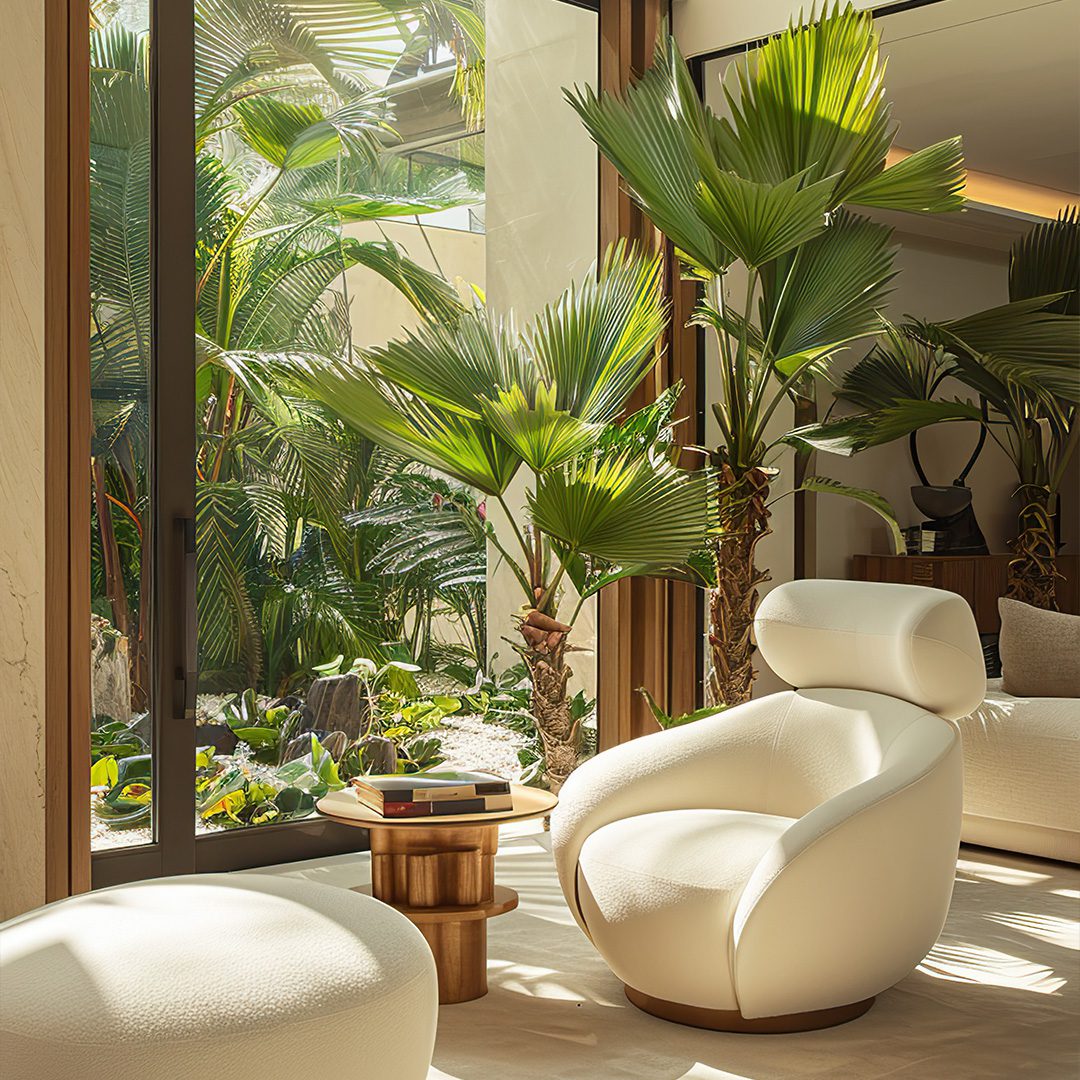
Texture does as much work as colour in this palette, arguably more. Boucle and textured linen upholstery, honed rather than polished natural stone, matte plaster wall finishes, and woven natural fibres in rugs and window treatments all add visual and tactile depth to a room without introducing additional colour or pattern. This is what stops a warm minimalist space from reading as flat or empty, the restraint is in the number of colours and objects, not in the richness of texture.
Small, considered accents, brushed brass or warm bronze hardware, a single piece of natural stone as a feature rather than covering every surface, provide just enough contrast and interest without disrupting the overall calm. The discipline here is genuinely important: warm minimalism fails the moment too many accent materials compete for attention in the same room.
It’s worth being specific about what to avoid, since the trend’s popularity has led to it being applied loosely. Cool-toned greys, even light ones, undercut the whole effect if mixed into an otherwise warm palette, since the eye reads the contrast as unresolved rather than intentional. High-gloss finishes, however neutral the underlying colour, also work against the style’s tactile, grounded quality. The rule worth holding onto is that every material in the room should feel like it could be touched comfortably, warm to the hand, matte to the eye, rather than cool or reflective.
Key Furniture Shapes and Proportions
Furniture shape has become as defining a feature of this style as its colour palette, and it’s one of the clearest visual signals separating warm minimalism from the sharper, more angular minimalism that preceded it.
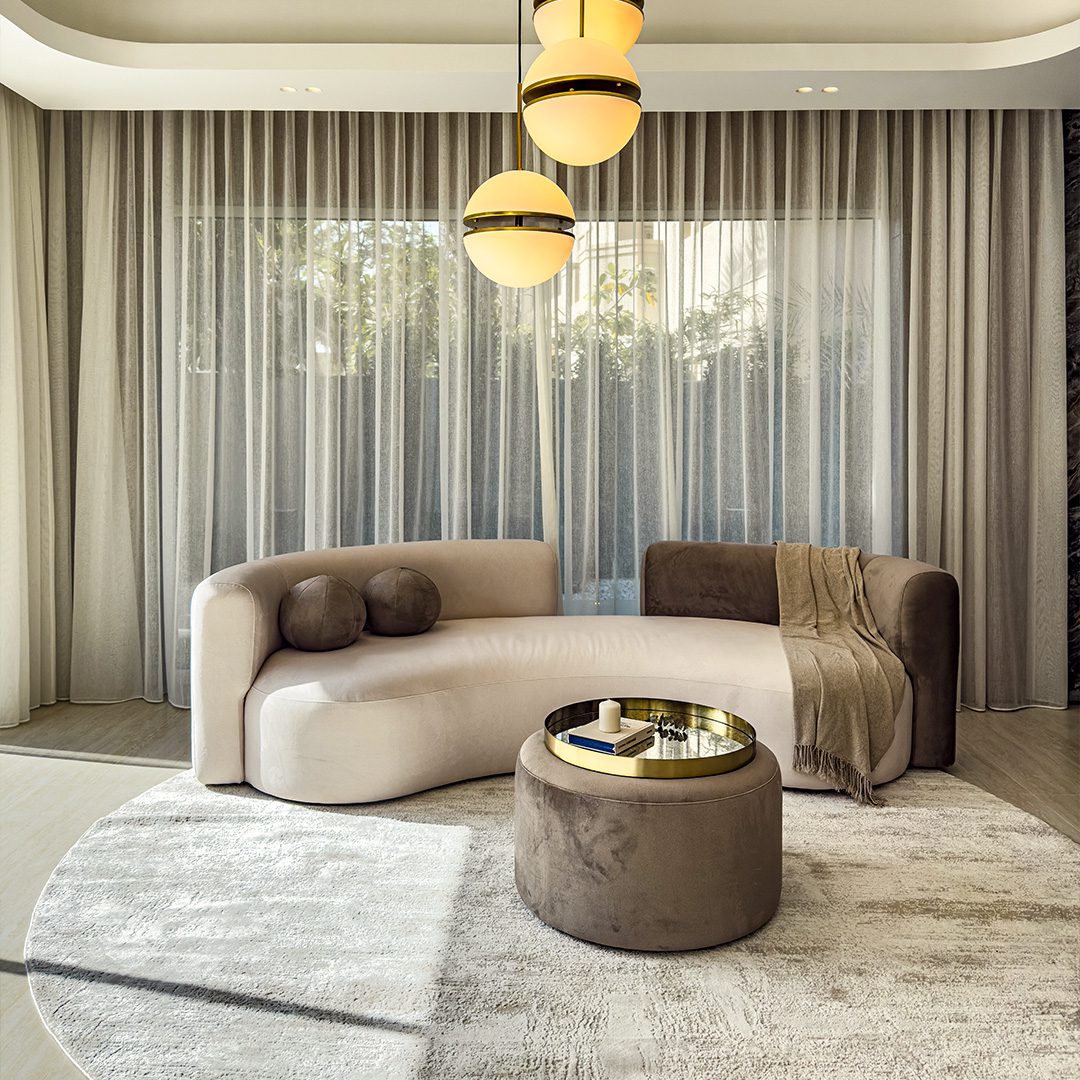
Curved and rounded forms, sofas with soft, enveloping arms rather than sharp right angles, curved bedheads upholstered in bouclé or textured linen, arched joinery and niches, have become one of the strongest signatures of this style across Dubai villas. The rounded shapes soften a room’s overall geometry and photograph as considerably more inviting than the hard-edged furniture that defined the previous minimalist wave.
Proportion matters as much as shape. Warm minimalist furniture tends toward generous, low-slung silhouettes, deep sofa seats, lower coffee tables, pieces that encourage sitting back and staying rather than perching briefly. This is a deliberate departure from furniture chosen primarily for how sharp it looks in a photograph, favouring pieces genuinely built for comfortable, extended use.
Bespoke interior design earns its place here more than in almost any other style, since off-the-shelf furniture rarely gets both the proportion and the exact curve profile right for a specific room. A sofa or bedhead built to the precise dimensions and proportions of the actual space, rather than selected from a catalogue and hoped to fit, is consistently what separates a genuinely successful warm minimalist room from one that’s simply following the trend’s surface signals.
Lighting That Adds Warmth
Lighting is arguably the single most important, and most commonly under-specified, element in a genuinely warm minimalist interior.
Colour temperature is the first decision, and it matters enormously. Warm-toned lighting, sitting well below the cooler, bluer light temperatures often used in commercial or purely functional spaces, is essential to warm minimalism’s entire premise. A room with a perfect sand-and-wood material palette lit with cool white light will still read as clinical, undoing much of the material work.
Layered lighting, ambient, task, and accent sources working together rather than a single central fixture, gives a warm minimalist room the depth and shadow play that makes it feel considered rather than flatly lit. Statement fixtures, often in warm brass or bronze tones, are used sparingly, over a dining table or staircase, rather than throughout the home, keeping with minimalism’s core restraint even in the lighting layer.
Dimming control across every layer lets a warm minimalist space shift convincingly from bright, functional daytime lighting to the soft, low evening atmosphere the whole style is ultimately chasing. This is a detail worth specifying explicitly at the design stage, since retrofitting proper dimming and layering into a space designed without it rarely delivers the same result.
Leif’s Approach
At Leif, warm minimalism isn’t a look we apply on top of a project, it’s close to how we approach every home by default. Our own description of what we do, shaping spaces around how people actually live rather than how they photograph, sits naturally alongside this style’s core principle: restraint in service of genuine comfort, not restraint for its own sake.
That means every material, proportion, and lighting decision in a warm minimalist project gets resolved together under one design and build process, bespoke joinery and furniture built to the exact proportions of the room, a considered lighting plan rather than standard fittings, and a palette chosen specifically for how it will actually live in your home’s light and daily use. If warm minimalism is the direction you’re drawn to for your own space, our design philosophy is built to deliver exactly this kind of considered, personal result.
Frequently Asked Questions
Is warm minimalism the same as minimalism? Not quite. Warm minimalism keeps minimalism’s discipline of restraint and clean lines, but replaces stark white and cool grey tones with soft neutrals, natural texture, and warm lighting, avoiding the clinical feel plain minimalism can have.
Why has warm minimalism become so popular in Dubai specifically? Warm neutral tones flatter Dubai’s intense, golden natural light better than cool colours do, and they show dust less visibly than stark white or grey surfaces, both genuine practical advantages alongside the aesthetic appeal.
Does warm minimalism work in a small apartment as well as a large villa? Yes, the principles scale down well since the style relies on restraint, texture, and lighting rather than large statement pieces, though proportions and furniture scale should always be considered for the specific space.
What’s the biggest mistake people make when trying warm minimalism? Getting the palette right but leaving lighting cool or flat, which undoes much of the warmth the material choices were meant to create. Colour temperature and layered lighting are just as important as the material palette itself.
Is bespoke furniture necessary for warm minimalism, or can I use off-the-shelf pieces? Off-the-shelf pieces can work, but bespoke furniture built to a room’s exact proportions typically achieves the curved forms and generous scale this style depends on more precisely than catalogue pieces adapted to fit.
Bring warm minimalism into your home
If warm minimalism is the direction you want for your space, talk to the Leif team about a palette, layout, and lighting plan built specifically for how you live.